
🌍 Introduction – Why Digital Productivity Matters in 2025
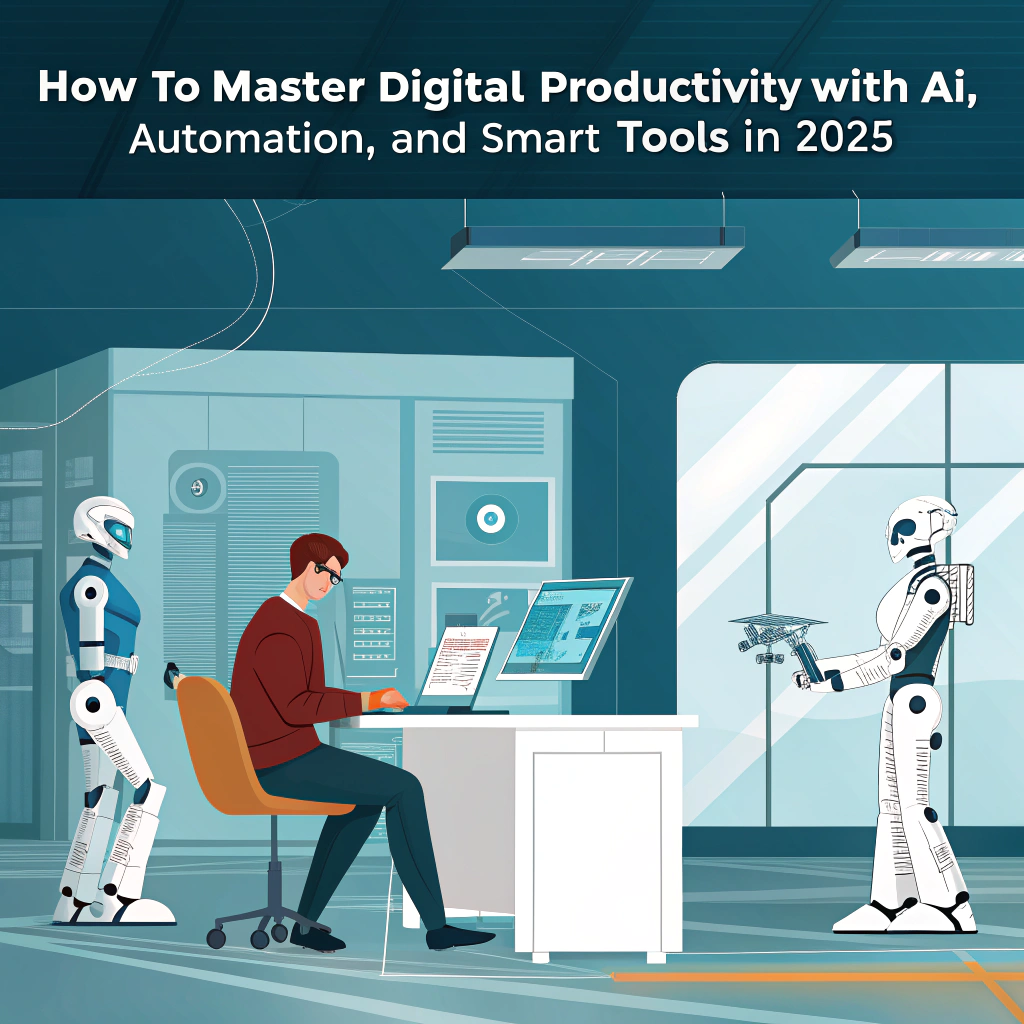
“AI, automation, and productivity in 2025 are essential for mastering digital workflows and achieving maximum efficiency.”How to master digital productivity with AI and automation in 2025 has become essential as the modern digital environment demands efficiency, speed, and adaptability. Today:
- AI and automation are revolutionizing workflows
- Smart tools reduce manual errors and save time
- Businesses and individuals must optimize digital processes to stay competitive
This comprehensive guide will teach you how to use AI, automation, and smart tools to enhance productivity, streamline operations, and maintain digital security in 2025.
This guide will help you:
- Identify tasks for AI and automation
- Learn step-by-step automation and AI integration
- Use smart tools for personal and business productivity
- Optimize workflows and streamline operations
- Maintain security and privacy while leveraging AI
- Stay ahead of emerging trends in digital productivity
This post is designed for entrepreneurs, students, professionals, and tech enthusiasts who want to maximize output while minimizing effort.
⭐ H2: 1. How to Identify High-Impact Tasks for AI and Automation
Step 1: Analyze Daily and Weekly Tasks
- Examples: emails, scheduling, reporting, repetitive content creation
Step 2: Evaluate Time and Complexity
- Identify tasks that take the most time or are prone to errors
- Focus on tasks that provide the highest return on automation
Step 3: Categorize Tasks for AI vs. Automation
| Task Type | Recommended Tool | Purpose |
|---|---|---|
| Repetitive Data Entry | Microsoft Power Automate, Zapier | Automate workflows |
| Customer Queries | AI chatbots, Dialogflow | Handle support requests |
| Marketing Content | ChatGPT, Jasper | Generate content quickly |
| Social Media Scheduling | Buffer, Hootsuite | Plan and post automatically |
| Analytics Reporting | Tableau AI, Power BI | Automate insights and reports |
⭐ H2: 2. How to Implement AI Tools for Personal Productivity
Step 1: AI Planning & Scheduling
- Use Google Calendar AI and Microsoft Copilot
- AI suggests optimal scheduling and prioritizes tasks
Step 2: AI for Research & Knowledge Management
- Use AI assistants (ChatGPT, Elicit) to summarize reports and research papers
- Automate information gathering and knowledge databases
Step 3: AI for Creative Work
- Generate presentations, blogs, and social media content with AI tools
- Use AI design tools like Canva AI for visual content
Step 4: Track AI Performance
- Monitor AI-generated outputs for quality
- Refine prompts and workflows for accuracy and relevance
⭐ H2: 3. How to Use Automation for Business Efficiency
Step 1: Map Out Business Workflows
- Identify repetitive processes in operations, sales, marketing, and HR
Step 2: Choose Automation Tools
| Tool | Purpose |
|---|---|
| Zapier | Connect apps and automate tasks |
| Make (Integromat) | Complex workflow automation |
| IFTTT | Simple task automation |
| HubSpot Automation | CRM and marketing automation |
Step 3: Implement Automation Step-by-Step
- Start with simple repetitive tasks
- Test automation carefully before scaling
- Gradually integrate complex workflows
Step 4: Monitor and Optimize
- Track performance metrics
- Adjust automation for efficiency
- Ensure no critical step is skipped
⭐ H2: 4. Step-by-Step Guide to Using Smart Productivity Tools
Essential Tools:
| Category | Tool | Purpose |
|---|---|---|
| AI Content Generation | ChatGPT, Jasper | Generate text, reports, ideas |
| Workflow Automation | Zapier, IFTTT, Power Automate | Streamline repetitive tasks |
| Cloud Storage | Google Drive, OneDrive | Centralized file management |
| Analytics & Insights | Power BI, Tableau AI | Automated data reporting |
| Social Media | Hootsuite, Buffer | Post scheduling and monitoring |
Step-by-Step Example: Automating a Social Media Workflow
- Create content calendar
- Use AI tool to generate captions and images
- Schedule posts via Hootsuite or Buffer
- Track engagement and feedback automatically
⭐ H2: 5. Security and Privacy Best Practices in AI & Automation
- Always use strong passwords and multi-factor authentication
- Encrypt sensitive data before uploading to cloud services
- Limit AI access to sensitive personal and business data
- Keep automation tools updated to prevent vulnerabilities
- Monitor access logs and AI tool permissions
⭐ H2: 6. Step-by-Step Blueprint for Maximizing Digital Productivity
- Identify high-impact tasks for AI and automation
- Choose appropriate AI and automation tools
- Implement step-by-step workflows for efficiency
- Track, analyze, and optimize results regularly
- Secure data and maintain privacy
- Continuously learn new AI tools and techniques
- Stay updated with productivity trends and emerging technologies
⭐ H2: 7. Future Trends in AI & Automation Productivity
- AI personal assistants integrated into daily life
- Fully automated business operations
- Predictive analytics and AI decision-making tools
- Smart office and smart home automation integration
- Enhanced security and privacy solutions for AI-driven workflows
⭐ H2: Conclusion
By following this how-to guide for 2025, you can:
- Leverage AI and automation for maximum productivity
- Streamline workflows and optimize personal and business tasks
- Maintain security and privacy while using AI tools
- Stay ahead of technology trends and emerging tools