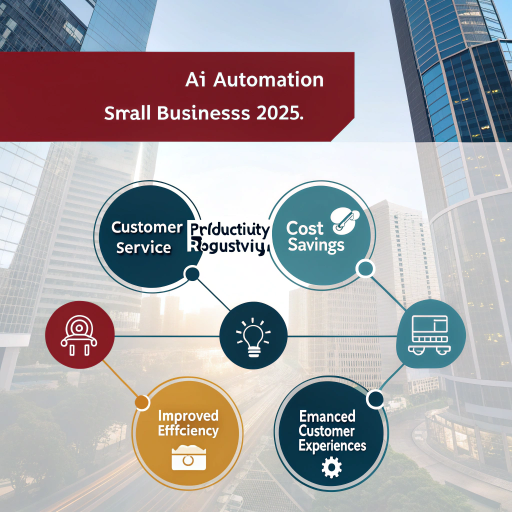

Introduction: The AI Revolution Reaches Main Street
In 2025, the most transformative wave of technology isn’t coming from Silicon Valley — it’s happening in small businesses around the world.
AI automation, once reserved for Fortune 500 companies, is now affordable, accessible, and scalable for startups, local shops, and solo entrepreneurs.
From automated marketing campaigns to AI-powered bookkeeping and personalized customer interactions, AI is no longer a luxury — it’s the new competitive baseline.
“In 2025, small businesses using AI are growing 2.5× faster than those that don’t.”
— TechNoWires Small Business Intelligence Report, 2025
1. Democratization of AI: From Corporate Labs to Coffee Shops
A decade ago, adopting AI meant hiring data scientists and investing in massive infrastructure. Today, platforms like ChatGPT, Notion AI, Zapier AI, and Microsoft Copilot have brought enterprise-level automation to anyone with Wi-Fi.
Why It’s Happening
Cloud-Based AI APIs: Instant integration without hardware costs.
Low-Code / No-Code Tools: Drag-and-drop automation flows for non-technical users.
AI-as-a-Service (AIaaS): Subscription models for scalable automation.
Example:
A small digital marketing agency can use ChatGPT-powered scripts to generate blog posts, automate email campaigns, and even design visuals — all within hours, not weeks.
“AI is the new electricity — and in 2025, it’s powering small business growth.”
2. Intelligent Marketing: Personalized Campaigns That Learn
Marketing automation has evolved far beyond pre-scheduled emails.
Today’s AI tools analyze audience behavior, predict preferences, and create personalized experiences in real time.
Key Tools Empowering SMBs:
HubSpot AI & Salesforce Einstein: Predictive lead scoring and behavior analytics.
AdCreative.ai: Automatically generates ad visuals optimized for conversions.
Jasper AI / Writesonic: Creates SEO-optimized content at scale.
Surfer SEO & Frase: Real-time content optimization using AI search intent analysis.
Use Case:
A boutique eCommerce brand uses AI-driven segmentation to deliver personalized product recommendations — boosting repeat sales by 35% and ad ROI by 50%.
Marketing in 2025 isn’t about reaching everyone — it’s about reaching the right one.
3. Smart Customer Service: Chatbots That Actually Care
Gone are the days of robotic, pre-scripted support bots.
Modern AI chatbots use natural language understanding (NLU) and sentiment analysis to deliver human-like, empathetic support 24/7.
Platforms Leading the Charge:
Intercom Fin AI — Context-aware support bots for small businesses.
Zendesk AI Assist: Predicts customer intent before response.
Drift & ManyChat: Multichannel chatbot systems (web, WhatsApp, Facebook).
Real Example:
A small online store can integrate ChatGPT API into its website for instant responses to customer queries, refund processing, and order tracking — all automated yet natural.
“In 2025, customer experience is powered by empathy — and AI has learned empathy.”
4. AI Inventory & Supply Chain: Predict Before You Run Out
For small retailers and local manufacturers, inventory mismanagement used to be a constant headache.
Now, AI predictive analytics can forecast demand, track trends, and automatically reorder supplies before shortages occur.
Smart Inventory Solutions:
Zoho Inventory AI — Predicts reorder cycles using historical sales data.
Shopify Magic — Auto-adjusts product listings and supply based on demand trends.
QuickBooks Commerce AI — Integrates finance + inventory insights.
Real-World Scenario:
A small grocery store chain uses AI sensors to track shelf stock in real time.
When an item drops below threshold, the system automatically triggers a reorder from suppliers — reducing waste and stockouts by 40%.
In 2025, AI doesn’t just count your inventory — it anticipates your next order.
5. Financial Automation: The AI Accountant Arrives
Accounting, invoicing, and payroll — once tedious, error-prone tasks — are now being handled with AI precision and automation.
Game-Changing Tools:
QuickBooks AI & Xero: Automated reconciliation, invoice matching, and forecasting.
Bench AI Accounting: Human + AI bookkeeping hybrid.
TallyPrime AI: Predictive cash flow analysis for small Indian businesses.
Brex Empower AI: Automated spend analysis and budget optimization.
Example:
A small consultancy uses AI to automatically categorize expenses, reconcile bank data, and generate tax-ready reports — cutting monthly accounting time by 70%.
“AI accountants don’t replace humans — they remove the busywork so humans can strategize.”
6. AI in HR: The Rise of the Automated Workplace
Recruitment, onboarding, and employee engagement are now powered by AI-driven HR tools that enhance team culture and productivity.
Smart HR Platforms:
Breezy HR AI: Resume screening and candidate scoring.
Zoho People AI: Predicts attrition and employee engagement.
Reclaim.ai: Smart meeting and task automation for small teams.
Deel AI HR: Automated payroll and compliance for global contractors.
Real Example:
A 10-person tech startup uses AI scheduling and time tracking to balance workloads — increasing productivity by 25% without adding staff.
“In 2025, HR isn’t human vs. machine — it’s human powered by machine.”
7. AI Tools Stack Every Small Business Needs in 2025
| Function | Tool Recommendation | Key Benefit |
| Marketing & Ads | Jasper, HubSpot AI | Smart campaigns & copywriting |
| Customer Support | ChatGPT API, Intercom Fin AI | 24/7 intelligent service |
| Finance & Accounting | QuickBooks AI, Brex | Automated bookkeeping |
| Operations | Zapier AI, Make.com | Workflow automation |
| HR & Productivity | Notion AI, Reclaim.ai | Smart scheduling & team efficiency |
| Data & Analytics | Google Cloud AutoML, Dataiku | Predictive insights for decisions |
Tip: Combine Zapier AI + Notion AI + QuickBooks for a low-cost, full-stack automation system under $100/month.
8. Predictive Decision-Making: AI as a Strategic Partner
Small business owners are now using AI analytics dashboards that transform data into actionable insights — predicting revenue, churn, and seasonal demand.
Popular Tools:
Google Analytics 5 + AI Insights
Zoho Analytics AI Assistant (Zia)
ChatGPT with Data Plugins
Microsoft Power BI Copilot
Example:
A SaaS startup uses AI to analyze churn risk and customer lifetime value, automatically prioritizing retention campaigns for at-risk users — saving $50,000 annually.
“Data is the new gold — AI is the refinery.”
9. Challenges: The Human Side of Automation
While AI brings speed and efficiency, small businesses must navigate new challenges:
Data Privacy Compliance (GDPR, CCPA): Handling customer data ethically.
AI Overdependence: Maintaining human oversight and creativity.
Integration Fatigue: Managing multiple automation tools effectively.
Skill Gaps: Reskilling teams to leverage AI tools strategically.
“Automation without understanding creates chaos — strategy must lead technology.”
10. The Future: Autonomous Small Businesses by 2030
By 2030, the next evolution is the self-operating small business — AI systems handling 80% of daily tasks autonomously.
What’s Next:
AI CEOs: Business intelligence models making data-backed strategic decisions.
Dynamic Pricing Algorithms: Adjusting prices in real time based on demand and competition.
Voice-Controlled Operations: Managing your business through AI assistants.
Ethical AI Frameworks: Ensuring transparency, fairness, and sustainability.
“The future small business isn’t automated — it’s autonomous.”
Key Takeaways
| Transformation Area | AI Impact | Growth Outcome |
| Marketing | Predictive personalization | +35% customer retention |
| Customer Service | 24/7 empathetic bots | +50% response efficiency |
| Finance | Automated accounting | –70% admin time |
| Operations | Workflow AI orchestration | +40% productivity |
| HR | Smart scheduling & analytics | +25% engagement |
Conclusion: From Local to Limitless
AI automation has erased the boundary between small and big business.
A café can now analyze customer behavior like Starbucks; a local agency can automate workflows like Accenture.
In 2025, intelligence is the ultimate equalizer — empowering small businesses to scale globally, serve locally, and compete fearlessly.
Google has redefined automation with Vertex AI, integrating AutoML with powerful APIs, BigQuery ML, and generative AI tools — making it ideal for enterprise-grade machine learning.
2. Amazon SageMaker Autopilot
AWS’s Autopilot automatically analyzes your dataset, chooses the right ML algorithms, and provides explainable models ready for deployment — perfect for cloud-native automation.
3. Microsoft Azure AutoML
With seamless integration into Azure ML Studio, this platform empowers developers with drag-and-drop interfaces, MLOps integration, and transparent model interpretability.
4. DataRobot
DataRobot remains a pioneer in enterprise AutoML, combining model automation, explainability, and governance — enabling responsible, scalable AI.
5. H2O.ai Driverless AI
Open-source and enterprise-friendly, H2O.ai focuses on transparency and explainability — crucial for regulated sectors like finance and healthcare.
Advanced Capabilities of AutoML in 2025
AutoML in 2025 is not just about automating algorithms — it’s about creating adaptive, intelligent, and explainable systems. Here are its next-level features:
Neural Architecture Search (NAS): AutoML can now design deep learning architectures automatically.
Cross-Domain Learning: Models learn from data across industries, improving contextual understanding.
Explainable AI (XAI): AutoML platforms provide interpretable models to ensure ethical compliance.
MLOps Integration: Continuous monitoring, version control, and retraining — all automated.
Edge AutoML: Deploy AI models directly to IoT devices or microcontrollers for real-time processing.
These advancements make AutoML not just a tool — but an AI ecosystem builder.
Real-World Use Cases: AutoML in Action
Healthcare
Hospitals use AutoML to predict patient readmissions, detect diseases early, and personalize treatment recommendations.
Finance
Banks deploy AutoML for fraud detection, credit scoring, and algorithmic trading. Models are retrained automatically as new data flows in.
Retail
E-commerce companies use AutoML to optimize dynamic pricing, forecast demand, and personalize recommendations based on customer behavior.
Manufacturing
Factories rely on AutoML for predictive maintenance — anticipating machine failures before they happen.
Marketing
Marketers automate customer segmentation, churn prediction, and campaign optimization — all driven by AI analytics pipelines.
How AutoML Is Powering the Generative AI Era
One of the most exciting developments of 2025 is how AutoML and Generative AI are working together.
Generative AI creates synthetic data and new model architectures, while AutoML evaluates, optimizes, and deploys them automatically.
Together, they form the backbone of self-evolving AI systems — capable of designing, improving, and learning without constant human intervention.
This integration is paving the way for AI 2.0 — fully autonomous intelligence ecosystems.
The Challenges of AutoML Adoption
Despite its transformative power, AutoML faces several key challenges:
Data Quality: Automation can’t fix biased or corrupted data.
Lack of Transparency: Some black-box models are hard to interpret.
Over-Automation: Risk of overfitting if not monitored properly.
Security Concerns: Automated pipelines can be vulnerable to data poisoning or model theft.
To counter these issues, the 2025 trend is Responsible AutoML — emphasizing explainability, fairness, and ethical compliance.
The Future of AutoML: AI That Builds Itself
By 2030, AutoML will evolve into Self-Adaptive AI, systems capable of designing and retraining themselves autonomously — without human oversight.
Future innovations will include:
AutoML + Generative AI Fusion for self-creating model architectures.
AI-as-a-Service (AIaaS) models powered entirely by automated pipelines.
Cross-Industry AI Collaboration, where AutoML systems share and optimize knowledge across domains.
In short, AutoML is setting the stage for the age of AI co-creation, where humans and machines collaborate symbiotically.
Conclusion: The True Power of AutoML
AutoML isn’t just a tool for simplifying machine learning — it’s a catalyst for intelligent innovation.
By merging automation with human creativity, it’s empowering organizations to move from data-driven to AI-driven decision-making.
In 2025, the companies thriving in the AI race aren’t just those that use machine learning — they’re the ones that have automated it.