
introduction: The Rise of a Machine-Driven World
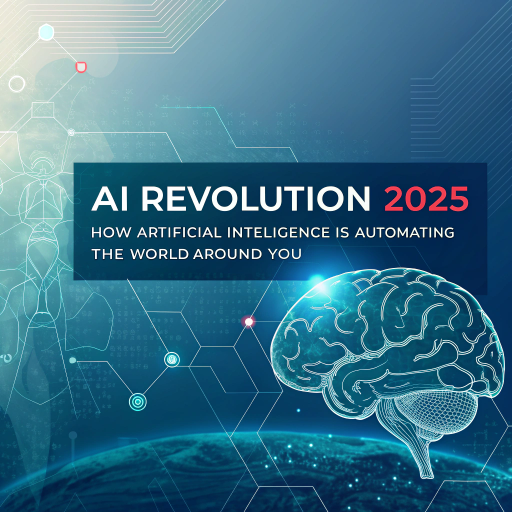
AI Automation 2025 is redefining the world around us. From healthcare and transportation to business and smart cities, artificial intelligence is automating every aspect of modern life.
2025 is not the year AI will “arrive.” It’s the year AI takes control — quietly automating our offices, hospitals, cities, and even personal decisions.
Today’s world runs on algorithms, not just electricity.
Machines don’t just follow commands — they learn, adapt, and decide.
From writing code to designing homes, from driving trucks to diagnosing diseases — AI automation has become the invisible engine of our modern lives.
Welcome to the AI Revolution — where intelligence is no longer just human.
What Exactly Is AI Automation (And Why It’s So Powerful)
Traditional automation is like a robot arm — it moves when told.
But AI automation is like a brain with hands — it thinks, acts, and improves over time.
At its core, AI automation blends:
Artificial Intelligence (AI) — the ability to learn, reason, and improve.
Automation — the ability to perform tasks with little or no human input.
Data Analytics — the insight that drives intelligent decisions.
How It Works
Data Collection: AI systems gather data from sensors, users, and networks.
Pattern Recognition: Machine learning algorithms analyze trends and predict outcomes.
Action Execution: Automation tools execute decisions — instantly and accurately.
Continuous Learning: The system improves itself with every new piece of data.
Result: Faster decisions, fewer errors, and limitless scalability.
Industrial AI — The Core of Modern Progress
1. Smart Manufacturing: Factories That Think
Gone are the days when factories ran on fixed schedules.
Now, AI-powered machines communicate, self-optimize, and predict failures.
Example:
A car manufacturing plant uses AI sensors that detect motor overheating in real time, alerting engineers before any damage happens — reducing downtime by 45%.
Key Technologies Powering Industry 4.0:
Industrial IoT (Internet of Things)
Predictive Maintenance
Computer Vision for Quality Control
Digital Twin Technology
By 2030, 70% of factories worldwide will adopt AI-driven automation systems.
Cognitive Automation — When Machines Begin to “Think”
Unlike basic automation, Cognitive AI can understand context and reason like humans.
It’s the foundation of tools like ChatGPT, Copilot, and Gemini AI.
Examples of Cognitive Automation:
Finance: AI systems predict market crashes or investment opportunities.
Healthcare: AI scans X-rays and MRI images faster than human radiologists.
Customer Service: NLP-based chatbots solve complex queries instantly.
In simple terms: Cognitive automation doesn’t just follow orders — it understands purpose.
Healthcare Revolution — Saving Lives with AI
The healthcare sector has become one of the biggest beneficiaries of AI automation.
Machines now help doctors, monitor patients, and even design new drugs.
How AI Is Healing the World:
AI Diagnostics: Detect diseases (like cancer or diabetes) early using image recognition.
Drug Discovery: AI predicts how new compounds will behave — cutting R&D time by 50%.
Virtual Care: Chatbots provide 24/7 health advice.
Robotic Surgery: Machines like Da Vinci perform ultra-precise operations.
Fact: According to PwC, AI could save healthcare systems nearly $200 billion per year by 2030.
The next doctor you meet might be a robot — or at least, assisted by one.
AI in Business — The New Corporate Backbone
Businesses have discovered the ultimate employee — one that never sleeps, never forgets, and never makes the same mistake twice: AI Automation.
Use Cases of AI in Business
Marketing Automation: AI creates personalized ads and email campaigns.
Customer Relationship Management: AI predicts client churn before it happens.
Finance & Accounting: Automates invoicing, billing, and fraud detection.
HR & Recruitment: AI tools shortlist candidates based on skill data.
Gartner predicts that by 2026, 80% of businesses will adopt at least one AI automation workflow.
Smart Homes — Living with Digital Intelligence
Your house is no longer just bricks and mortar — it’s an intelligent digital assistant.
Examples of AI in Smart Homes:
Smart thermostats adjust temperature using weather forecasts.
Voice assistants like Alexa and Google Home learn your habits.
Security cameras recognize family members vs intruders.
Appliances operate during low-cost electricity hours.
According to Statista, over 450 million homes will have AI-powered devices by 2030.
Your home won’t just follow commands — it’ll anticipate your needs.
Transportation & Mobility — Driving into the Future
The world of transportation is shifting from manual driving to autonomous navigation.
AI and automation are making travel safer, faster, and greener.
Applications of AI in Transport
Self-Driving Cars: Tesla’s Autopilot and Waymo’s AI fleets dominate highways.
Rail Systems: AI manages schedules, speeds, and power usage.
Freight & Logistics: Predictive routing minimizes fuel and time.
Drone Deliveries: Amazon and Zipline deliver packages with pinpoint accuracy.
Result: 25% reduction in urban traffic congestion through predictive traffic control.
Smart Cities — AI Runs the Urban Future
Smart cities are the ultimate example of automation meeting sustainability.
How AI Powers Smart Cities
IoT Sensors: Monitor traffic, pollution, and power usage.
Energy Grids: Optimize energy distribution in real-time.
Public Safety: Facial recognition and automated alert systems.
Citizen Services: Chatbots handle complaints and billing.
By 2030, more than 50 global cities will be fully AI-integrated.
The Human Impact — Jobs, Ethics & Opportunities
Of course, every revolution has a cost.
AI is automating millions of repetitive jobs — from call centers to assembly lines.
Jobs at Risk
Data entry clerks
Cashiers
Drivers
Basic-level customer support
But it’s not all bad news.
New Careers Emerging
AI Trainers & Data Annotators
Machine Learning Engineers
AI Ethics Consultants
Automation Strategists
World Economic Forum estimates that AI will create 97 million new jobs by 2030 — even as it replaces others.
Ethical Challenges — Keeping AI Human-Centered
As automation grows, questions arise:
Who is responsible when an AI makes a mistake?
How do we ensure fairness in machine decisions?
How much privacy are we willing to trade for convenience?
Key Ethical Principles of AI Automation:
Transparency: Know how decisions are made.
Accountability: Hold systems responsible for outcomes.
Privacy: Protect user data from misuse.
Fairness: Eliminate bias from algorithms.
The goal isn’t to make AI perfect — it’s to make it ethical and aligned with humanity.
The Future Ahead — Automation Without Limits
The next decade will redefine the relationship between humans and machines.
Predictions for 2035
Fully autonomous factories run by self-learning robots.
Cities where traffic, power, and safety are managed by AI.
Personalized education powered by adaptive AI tutors.
Digital coworkers (AI agents) collaborating in real-time.
AI will become the foundation of civilization, just like electricity was in the 20th century.
“Automation isn’t about replacing people. It’s about upgrading humanity.”
Conclusion: The World Is Becoming Self-Driven
The AI Revolution isn’t coming — it’s here.
Every click, every photo, every spoken word fuels a machine that learns more about the world and about you.
Whether we embrace it or fear it, automation is now the heartbeat of progress.